Most responses to menstrual health challenges focus on a single moment — a distribution drive, an awareness campaign, a once-off donation. These efforts matter. But menstruation itself is not a moment. It is continuous, monthly, and spans decades of a person’s life.
The Middflow Model is built on a simple premise: access systems should reflect the same continuity as the biological reality they are designed to support. That requires looking beyond products and campaigns — toward the interconnected systems that shape whether access is reliable or fragmented.
This gap — between the continuous nature of menstruation and the episodic nature of access support — is what the Middflow Model is designed to address. When support appears for a moment and then disappears, people are left to manage on their own every month. The Middflow Model asks: what would it look like to design access systems that match the rhythm of menstruation itself?
Menstrual health access is not shaped by a single factor. It sits at the intersection of six interconnected systems — each one influencing the others, each one essential to making access reliable.
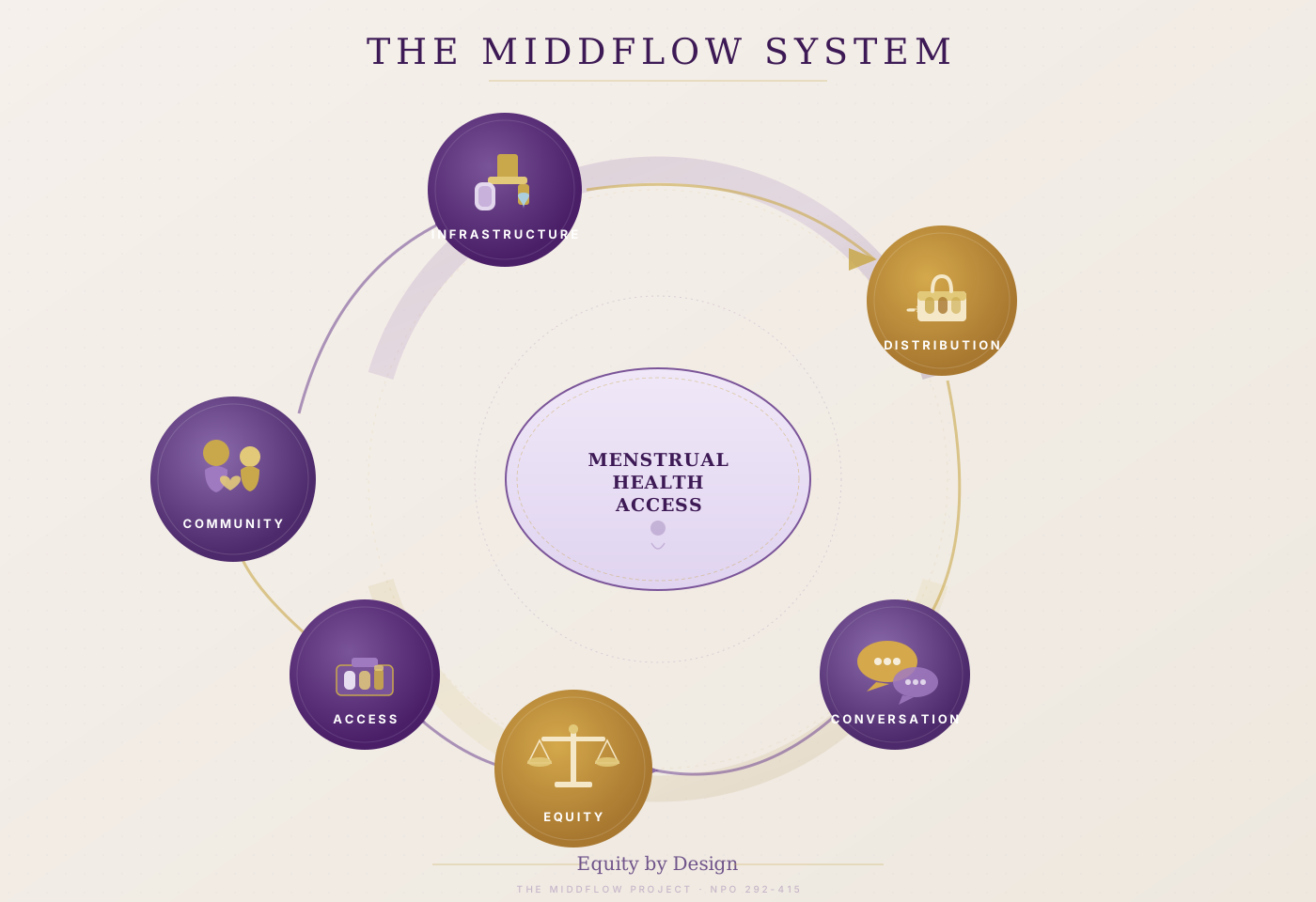
The Middflow system diagram illustrates how Community, Infrastructure, Distribution, Conversation, Equity and Access interact as a continuous ecosystem. Each node represents a system that influences whether access is reliable or fragmented.
Communities are both the context and the mechanism through which menstrual health access functions. Local knowledge, social norms, peer support, and community organisations all shape whether access is supported or stigmatised. Strengthening community systems means building environments where menstrual health is ordinary, visible, and supported.
Physical infrastructure determines whether access is practically possible. Safe water, sanitation facilities, private spaces, and disposal infrastructure are all essential. Without them, even the most well-intentioned distribution programme fails in practice. The Middflow Model examines infrastructure as a foundational layer of menstrual health access.
How products move from supply to access point is one of the most critical — and most overlooked — aspects of menstrual health systems. Distribution networks include NGO partners, school systems, clinic partnerships, retail channels, and community programmes. When distribution is reliable and consistent, access reflects that consistency. When it is fragmented, so is access.
Silence shapes systems. When menstrual health cannot be spoken about openly — in homes, schools, workplaces, or healthcare settings — it becomes harder to advocate for, design around, or fund consistently. The Middflow Model treats the normalisation of conversation as a systems-level intervention, not just a communication goal.
Equity is both a goal and a design principle. Menstrual health access is unevenly distributed across income levels, geographies, life stages, and social contexts. The Middflow Model treats equity not as an outcome to be achieved at the end of a process, but as something that must be intentionally designed into every layer of the system from the beginning.
Access is the outcome — but it is also a system in itself. Whether a person can reliably obtain menstrual products when they need them depends on all five systems above functioning together. Access is the point at which community, infrastructure, distribution, conversation, and equity either converge into reliability — or fracture into improvisation.
The Middflow Model is not a programme. It is a framework for thinking about how menstrual health access can be made more consistent, more equitable, and more durable — across the environments where daily life actually happens.
It recognises that menstrual health does not occur only in schools or clinics. It happens in homes, workplaces, public transport, community spaces, and markets. Designing for continuity means designing for all of these environments — not just the most visible ones.
“Menstruation is continuous.
Access must be too.”
When systems work together — when community awareness supports distribution, when infrastructure enables access, when conversation reduces stigma, and when equity is built into every design decision — access becomes reliable. Not a lucky outcome. A designed one.
